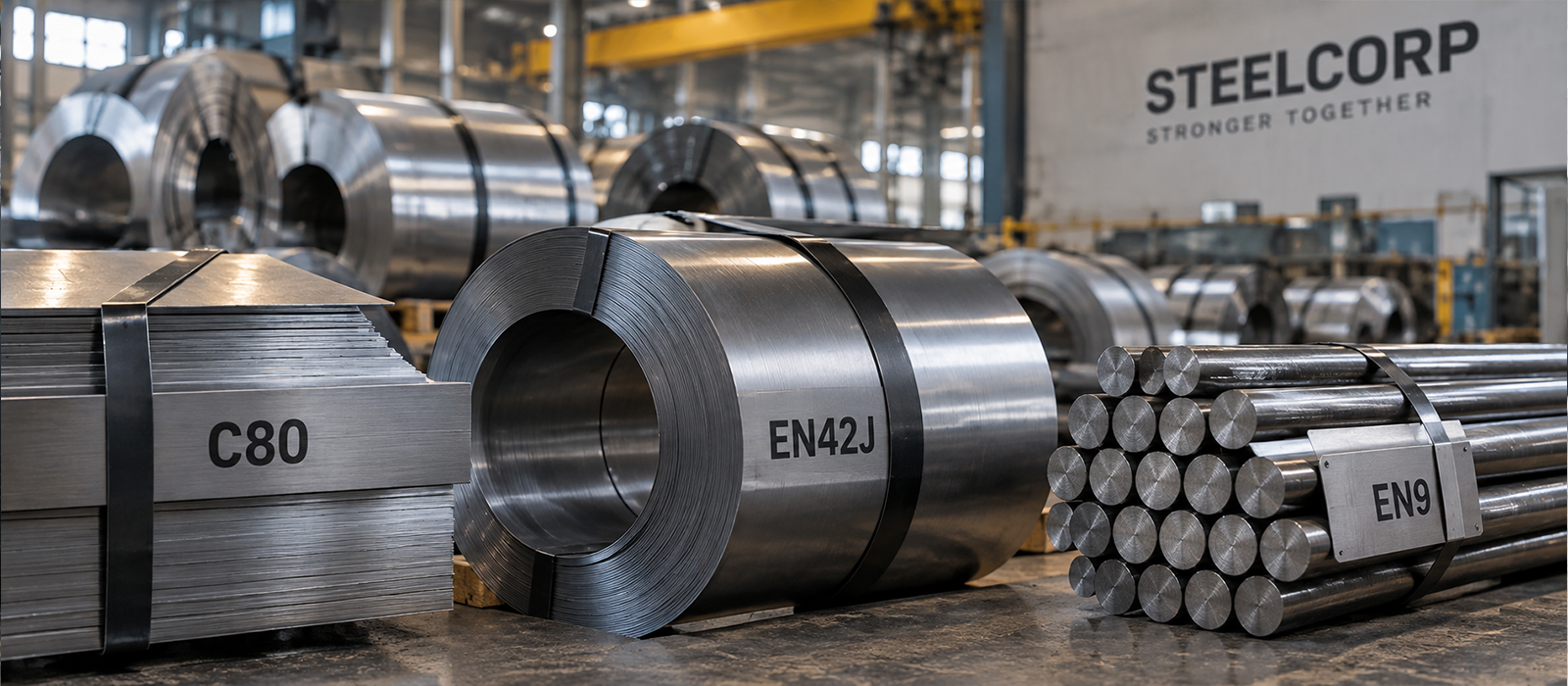
Selecting the right steel grade is important when manufacturing components that
require specific levels of strength, hardness, flexibility or wear resistance. C80 material,
EN42J material and EN9 steel are grades that can be considered for different
industrial applications, depending on the required performance and processing
conditions.
While these grades may appear similar in some applications, their characteristics and
suitability can differ. Understanding their general properties can help manufacturers
make more informed material choices.
C80 material is a high-carbon steel grade commonly associated with applications where strength and hardness are important. Its carbon content allows the material to achieve suitable mechanical properties through appropriate processing and heat treatment.
C80 may be considered for applications involving components that require a combination of strength and hardness. Depending on the required condition and processing, it can be used in spring-related and industrial applications. The exact suitability of C80 should always be evaluated against the required thickness, hardness, forming process and final application.
EN42J material is another spring-related steel grade used where suitable strength and spring properties are required. Material selection for spring applications depends heavily on the component design, operating conditions and required mechanical properties.
EN42J can be considered for applications involving spring components and other products where appropriate strength and resilience are required. The final performance depends on the condition in which the material is supplied and how it is processed.
EN9 steel is a medium-to-high carbon steel grade known for its useful combination of strength and hardness. It can be used for engineering components where mechanical performance and durability are important.
EN9 can be used in various engineering and industrial applications, particularly where components require good strength and resistance to wear. The appropriate condition and heat treatment depend on the specific end use.
C80, EN42J and EN9 should not be selected simply because they are all carbon steel grades. The correct material depends on the requirements of the finished component.
Start by identifying whether the component requires spring properties, hardness, wear resistance, flexibility or a combination of these characteristics.
The manufacturing process also matters. Cutting, forming, heat treatment and other processes can influence the final properties of the steel.
Thickness, width, hardness, tensile strength and surface condition should be discussed with the steel supplier before placing an order.
C80 material, EN42J material and EN9 steel can each have a place in industrial
manufacturing, but choosing between them requires an understanding of the
application's technical requirements.
Rather than selecting a grade based only on its name, manufacturers should consider
the complete set of material and processing specifications. Working with an
experienced steel supplier can help ensure the selected grade and supply condition are
appropriate for the intended application.